|
|
ESPAÑOL |
|
ST. LOUIS, MISSOURI.
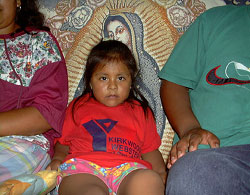
Looking at a map of the United States, St. Louis is near the center, both in east-west and north-south terms. It is also at the center historically and culturally. It is an industrial city in the midst of agricultural plains, a city equidistant from the great northern beacon of Chicago and Little Rock, a city important to the history of the southern United States. At the intersection of the Mississippi and Missouri Rivers, St. Louis was the "gateway" through which the early Americans looked at their future, the westward expansion of the mid-1800s. All the migrants that headed towards California had to cross the Mississippi River. For the migrants of today, St. Louis is also a gateway. The Mexicans look through the famous Gateway Arch towering over the riverside, but they are looking east, not west. After crossing the Río Grande (or the Río Bravo, as it is known on the Mexican side of the border), the Mississippi is another crossing on a journey that is taking them clear across the continent. It should not come as a surprise that Mexicans are in the "heartland" of America. Migrants have been working in states like Iowa and Illinois for decades. But their presence has dramatically increased in recent years. As with every other migrant destination, it was the job market that brought them here. Picking in tomato fields, tending rooms in hotels, bussing tables at restaurants downtown... the American economy is booming these days not just for the "natives," but for the migrants among us. The problem is that the boom for the migrants (as well as for many working-class "natives") is at the absolute bottom of the economy–in agriculture and the huge "service sector." And, unlike previous generations of migrants, there is no guarantee that these jobs will prove "stepping stones" to the middle class. Some economists believe that what we are seeing is the creation of a permanent "underclass," which will be stuck, generation after generation, at the bottom. With the sorry state of public education, the loss of affirmative action programs, the rapid technologization of the economy and the widening gap between rich and poor, it appears a strong argument that this might be the case. The migrants don't believe that, of course. ____________ Tuesday (June 9) was a hellish travel day, with almost-missed flights, delayed flights, not enough time to pay the bills or pack or get to the airport. I was anxious the entire day. It is an anxiety born out of constant movement. In following the migrants over the past few years, I've lost many of my romantic "On the Road" (as in Jack Kerouac) notions about migration. My sense of "home" is hopelessly fragmented. This has had an impact on every aspect of my life, in particular my friendships and romantic relationships. And yet... a sense of adventure remains. I don't think I experience the movement the same way Mexican migrants do–when it comes down to it, I have much more of a choice over where I'm going. But I do sense in them the same tension that I feel between past and future, the stress of situation in which practically every arrival brings with it the premonition of a new departure. This feeling always comes to me strongest in airport lobbies. At LAX and then again in Denver, where I catch a connection to St. Louis, I am unspeakably sad, staring at the banks of telephones and wondering who I can call so that I can feel that I am still, somehow, connected to a place, to people, to myself. I get only voice mail. ____________ Rosa Chávez lives in St. Louis with her husband Wenseslao Cortés and their daughter Yeni in a housing project near Lambert International Airport. So close, in fact, that jets on take-off or landing drown out our conversation with them every few minutes. Rosa is among the surviving siblings of the Chávez family, whose brothers Benjamín, Jaime and Salvador were killed in 1996 shortly after crossing the border (see May 31-June 1 dispatch, and "The New Americans" essay in the Zonezero galleries). Rosa was living and working in St. Louis at the time and returned home to bury her brothers. She remained in Cherán for several months. At first, she didn't seriously consider returning, thinking mostly of her grieving mother and the horrible anxiety she'd be put through were Rosa to attempt the dangerous crossing yet again. But in early January of 1997, Rosa did cross yet again, the memory of her brothers painfully present every step of the nearly 2,000 mile journey. She thought of them as she boarded the bus in Cherán and the tearful goodbye with her mother. She thought of them as she lay crouching by the side of a small road near Nogales, Arizona, waiting for a coyote's van to pick them up. And she thought of them as the overloaded van raced away from the border zone. Her daughter Yeni was in her arms the whole way. She says that Yeni is the reason she took the risk.
Rosa harbors few illusions about her own prospects in America. Now and again she talks of taking English classes, computer courses, perhaps cosmetology school. But she knows that it is Yeni, who will be four next month, who has the best chance of the life that the people of Cherán fantasize–basically a middle-class existence. _____________ When we arrive, Rosa is watering the flowers that she's planted in tin cans on her second-floor balcony. Yeni is inside, playing with a gorilla doll that starts singing the "macarena" at the clap of a hand. When I first met Yeni two years ago, she was an extremely introverted two year old. She rarely spoke to anyone except her mother and a few toddler friends. There was a deep sadness to the child. Surely, she'd absorbed the tragedy around her. Yeni is not exactly gregarious today, but she is much less shy than she was. Out of a tragedy that few people can imagine overcoming, the Chávez-Cortés family is slowly but surely carving out a future. Tomorrow, we will try to gain the trust of the patrón at Thompson Farms, where Rosa, Wenseslao and his brothers Baltazar, Gaspar and Melchor all work. It is a small farm literally next door to the housing project where all live together in a small two-bedroom apartment. There is, of course, no guarantee that we will. The weather is hot and humid, as if the Mississippi was a great stream of boiling water... ____________
|
|