|
|
ESPAÑOL |
ST. LOUIS, MISSOURI.
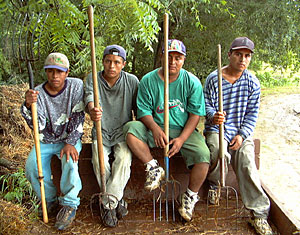
Jim Thompson (not his real name, for reasons that will become obvious) is a fifth generation farmer whose small parcel on the outskirts of St. Louis produces an amazing variety of crops: Strawberries, raspberries, blackberries, squash, peaches, tomatoes, chiles, eggplant, cucumber. There are also several greenhouse nurseries on the property, with dozens of species of house plants and flowers. About 25 years ago, the "help" on this farm–at the peak of the season, there are only a couple of dozen employees–was all African American. Today it is practically all Mexican. And more: the workers are all Mexicans from the town of Cherán, Michoacán. The Román family was the first from Cherán to migrate to the area, then the Izquierdos, and finally the Chávez-Cortéz, who are the most recent arrivals. In Cherán, relatives of these families live within blocks of each other, as they do here. It is a classic example of migrant networking ingenuity. As for the working conditions, they are probably far better than they were at the turn of the century, but are also in apparent violation of several modern-day standards. There is no overtime pay, even when the crew works a seventh day, which they often do at peak. And no health insurance, even though everyone works well above the minimum number of hours considered "full-time." There is a one-hour lunch break, but no official breaks in the morning or afternoon. The worst violation is of child labor laws. The youngest Cortéz brother, Gaspar, is only fourteen years old. He works fulltime at the Thompson farm.
Rosa, Wense and brothers Baltazar, Melchor and Gaspar get up at six, are at work by seven, and call it quits by five in the afternoon. A ten-hour day for which they are paid nine hours at $5.75 an hour. But they aren't about to complain. They are all undocumented–something farmer Thompson is also quite well aware of, since he often loans money to the Cortéz family to pay coyote fees when they return from sojourns in Cherán–except for Baltazar's daughter, Stefani, who was born in the U.S. Ironically, Stefani, along with her mother, Victoria, is visiting family in Michoacán right now, and will have to cross the border illegally to return to St. Louis with her undocumented mother. Most of the time, the Cortéz's seem quite grateful to the patrón–for the loans, for help in securing housing, for time off pretty much whenever and for however long (a month or two to return home at the end of the year, for example). Jim Thompson is a personable sort. He looks you in the eye with his sky-blues that peer out from under his shock of dirty-blond hair. He's a hands-on farmer, with hands usually caked with Mississippi valley mud. I ask Thompson what happened to his African-American help. "They just don't want to work this hard," he says, raising uncomfortable issues of race and class that are rarely discussed in the debate over immigration. "Maybe it's because there's a stigma attached with farm labor. They'd rather work at a MacDonald's for the minimum than on a farm for the same money... you can't blame them, I suppose. If I'd come from slaves, I might feel the same way... " Notwithstanding his fast and loose playing with labor codes, it would be hard to describe Thompson as an abusive patrón. Like Miguel Ramos, the strawberry grower in Watsonville, there is a patronizing benevolence about him. An unspoken bargain has been made: the workers won't inquire about raises or breaks or health insurance–and the patrón will fill out the immigration paperwork on their behalf without raising an eyebrow over obviously fake documents. The question that most needs to be asked, however, is: Who benefits most from this bargain? The Chávez-Cortéz family willingly accepts these conditions (although Baltazar sometimes wonders aloud whether he might have a better time of it in another job, such as construction). From a historical perspective, this might be seen as the "sacrifice" of the first generation, just as European migrants worked in the sweatshops, and in the fields, and trudged along the streets of New York with pushcarts. But that generation also was instrumental in the birth of the union movemement, which dramatically improved conditions in the workplace, and saw many of its children enter the middle class. The labor movement in the United States has been on the defensive for the last two decades, and there is no guarantee that attempts at reviving it (such as the UFW's strawberry campaign in Watsonville) will succeed. The children of today's migrant generation are also entering a public school system that is in crisis. Working conditions often translate into living conditions. The Chávez-Cortéz children, Stefani and Yeni, are growing up in a hardcore neighborhood. Living conditions often translate into obstacles to academic achievement and economic improvement.
Will the Chávez-Cortéz family be able to overcome odds that appear to be increasingly stacked against their acheiving a modern-day version of the American Dream? Or will the dream turn a perpetual waking nightmare? Meanwhile, Thompson's business is holding its own in an economy hostile to small farmers. He has a retail store just a few yards away from the fields where the Chávez-Cortéz family works. A steady stream of customers stops by, mostly middle-aged Anglos shopping for fresh berries and homemade jams. Occasionally, the Mexicans and the whites meet–the workers have to walk through the store to get a drink of water from the faucet in the back room. It is as close as these two worlds ever get in St. Louis. ____________ We are at the Chávez-Cortéz apartment after work. Rosa is out doing laundry. The Cortéz brothers lounge about the living room before the 19-inch Sanyo TV, which receives, via pirated cable, HBO, Showtime, Cinemax and Univision, the Spanish-language network. They often spend their evenings watching the latest action-adventure flicks, siding with the good guys who speak in a language they can barely understand against the villains who they actually resemble, at least in terms of skin color.
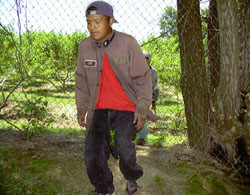
Although he's only 23, Baltazar is the de facto father figure in the household. He's the first-born son, speaks the best English, has the nicest car (a powder blue 1983 Buick Regal), and just happens to be the fairest-skinned of the brothers. Rosa's husband Wense is the next in line at 21, but he doesn't appear to wield too much power in the apartment or on the fields. Ever since I met Wense and his brother, I've noticed a tension between them. When Balta isn't around, Wense will confide his hopes and worries. But when in his brother's presence, he often turns brooding and taciturn. There is something of Cain and Abel between them. Wense is the outlaw type, having left home when he was barely 13 years old to try his luck in the States. A teenager running the migrant trail alone has no older brother or father to rein him in, and Wense has seen his fair share of trouble. Drinking and fights in the migrant bars, a serious car accident, financial pressures even greater than for the typical migrant. He careens from a deep sense of responsibility to his wife and daughter and family back home to an equally deep wild streak. Baltazar, of course, is the opposite. Abel can do no wrong; Cain is always jealously acting out. Even physically, Balta and Wense have little in common. Wense is corpulent and his skin is the darkest of the family, a chocolate brown (only his daughter Yeni's is darker). Skin color in Mexico plays a role nearly as important as it does in the U.S.–"Indian" looks translate directly into discrimination, and, often, self-loathing. In contrast to Balta's succession of used but clean and well-running cars, Wense's are always on the verge of a breakdown. Right now he has an '85 magenta-and-silver Monte Carlo, with racing rims and gaudy decals on the rear window, a real "Mex-mobile." But over the time I've known him, Wense has made a tremendous effort at straightening out his life. He now drinks only occasionally and when he does, it no longer automatically means an all-night drunk. He is a conscientious worker. Although money is tight, he meets his bills, pays back the loans he takes out, and still budgets himself well enough to send up to $300 back home to his family. He is thinking about the future. _______ One of the great lessons I've learned from Joe is about the necessity of intimacy in documentary work. To achieve intimacy one must constantly take risks, moving ever deeper into the subject's private physical space. This is the only way to begin a journey into the subject's psychological and spiritual space. And so tonight Joe walks into the bedroom that Melchor and Gaspar share–something I would never have done. Me, I wouldn't have gone in if I hadn't been invited; I would have felt that to be impolite at the least, or, at worst, a violation of a sacred space. But there is no such thing as a sacred space in documentary work.
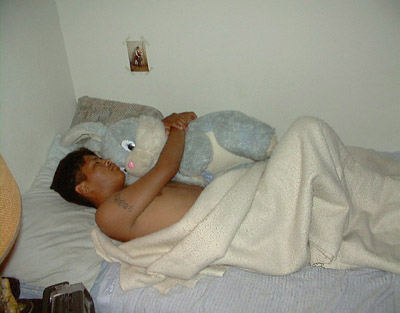
Gaspar and Melchor are exhausted from the day's work. Half-clothed, half asleep, they allow him to do his work. Melchor, in a moment of disarming vulnerability hugs a huge rabbit doll. On the wall is a photograph of his wife and kids back home in Cherán. It's been several months since he's since he's seen them, and he says it might be another year and a half before he returns home. _______ The kid brother, Gaspar, is enthusiastically playing the role of "norteño" ("northerner," as people back home call the migrants) in his new home. He is fond of wearing impossibly baggy pants, equally oversized basketball jerseys, and spanking-new Nike sneakers. Like every other migrant from Cherán that we know, he is a faithful fan of the Chicago Bulls, Michael Jordan his hero. Gaspar is mostly shy around us. But he does become animated when he tells us of his first and only border crossing with Melchor and Balta. They crossed the Río Bravo near the town of San Luis Río Colorado, a border outpost of the Sonora desert. It was in the midst of the "el Niño"-inspired winter, and the river was wide, deep and rapid. The coyote strung together a few old innertubes for the crossing. They struggled with the current for only ten or fifteen minutes, but in that time, every muscle in their body went numb from the cold and from the effort. "Hold on, just hold on, don't let go no matter what!" Baltazar told him. The river, of course, was stronger than his body and he felt that he wasn't going to make it. But he did. He says, he doesn't want to go back home, if for no other reason than never having to breach that damn river ever again. ________ Baltazar dials 0-1-1, then 5-2, then 4-5-9, codes for longdistance access, Mexico, Michoacán and the highland plateau where Cherán is nestled, respectively, and then the number of the long distance phone booth back home in Cherán. Perhaps half of Cherán's residents have telephones. But "Charly," as one of the local "coyotes" (people-smugglers) is nicknamed, does not. An operator-messenger must be sent walking up the street to summon him. Balta is told to call back. For the next 20 minutes, he is distracted from the conversation and TV-watching in the living room, where Yeni adds to the bustle by playing with her "Macarena" and dinosaur and horse and rabbit dolls.
When he dials again and connects, he takes the phone back to the bedroom. Joe, of course, follows him. The deal is struck. Charly will guarantee to deliver Balta's wife Victoria and his daughter Stefani to St. Louis Lambert International Airport for a fee of $1200. She will leave at the beginning of next week. They will likely cross the border somewhere in the desert of Arizona or east Texas, avoiding the river. Baltazar has not seen Victoria for nearly six months. ________ The apartment complex where the Chávez-Cortéz family lives is called Crystal Gardens, though there is little of either in these environs. There is a persistent stench from a garbage bin that hasn't been emptied in who knows how long. Bin fires are also common, when local teens are bored and want some excitement. Garbage is also not confined to the bins, but strewn across lawns whose grass grows wild. There is gang and drug activity.
But there are also working-class residents working one or two jobs, as secretaries, mechanics, casino clerks and Federal Express delivery people. There are small children who play jump-rope and hop-scotch. And there is a well-kept swimming pool, whose waters shimmer amber from the outdoor lights in the evenings. As recently as 10 years ago it was an all-black complex. The Mexicans now make up perhaps 10 percent of the population. Notwithstanding the physical intimacy of Mexicans and blacks at Crystal Gardens, there is little social contact between the two. We chat with some black residents, looking for clues as to what the future might hold for the relationship between the two largest "minorities" in the United States–one whose population is growing and concentrating itself in enclaves (the Mexicans), and the other whose population is dispersing (or being displaced) from its traditional urban neighborhoods (the blacks). From many African Americans living in increasingly Mexicanized neighborhoods, I've sensed a mix of sentiments regarding the new arrivals: curiosity, bewilderment, solidarity, envy and, sometimes, downright anger at perceived or real competition in the job market, the housing stock or the halls of political power. Marvin Whitson, a fifty-one year old Tenneesse native on disability, is the Chávez-Cortéz's neighbor in apartment A downstairs. He invites us in to his sparely furnished apartment, where he lives with his wife Deborah. He counts himself a fan of the immigrants. "They're doing better than some of the blacks," he says, noting, in particular, the Mexicans' love of good-looking (if not well-running) cars. "Lot of people I know say these people are into gangs, but I don't see it." The way Whitson sees it, most of the troubles in the complex come from African-Americans. "I wish they was nobody but me and the Mexicans. I wish the blacks would move."
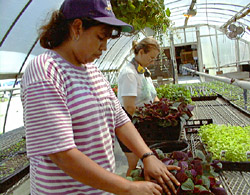
Later, Marvin's neighbor, 32 year-old schoolbus driver Brian Gaines, tells us something that we've heard on many stops along the migrant trail where we've found Mexicans and blacks living together. "We can take the Mexicans, the Chinese, we can all get along," he says. "But we just can't get along [with white people] for some reason." At Crystal Gardens, at least, there has been no outward aggression between the groups. Perhaps tensions remain low because, at least for the moment in St. Louis, there is little direct competition in the job market. Mexicans are mostly working the farms that African-Americans abandoned for industrial and other urban jobs. Like farmer Thompson said–a cliché, but a very true one–no other group is willing to work the fields anymore. While surely there must be latent xenophobia among some blacks, the attitude of Mexicans towards them is unmitigatedly negative. Save the kids, every single member of the Chávez-Cortéz family has spoken to me about "los morenos" in deprecating tones. Sometimes, they'll even call them "mayates," a rather ugly epithet in Spanish. The great irony is that the Mexican immigrants–particularly the young–are acculturating black, not just in St. Louis, but across the country in inner cities that are increasingly black-brown. Wense, who openly expresses no love lost with African Americans, often listens to a local black Hip Hop station on his car stereo, when he's not blasting banda tapes. And in terms of dress style, the only way you can tell the difference between black and brown here is precisely through skin color: all kids wear the uniform of the urban kid-warrior–baggy pants or shorts, oversize T-shirts or jerseys. And, of course, everyone's a fan of the Chicago Bulls and Michael Jordan. _______ It is 96 degrees with 100 percent humidity inside one of the greenhouse nurseries at Thompson Farms. Rosa Chávez works side-by-side with Pat Zimmerman, one of the few non-Mexican employees. They sow shoots of Swedish Ivy into trays filled with dark soil. The heat comes from both a suffocating Missouri summer day and the amber nursery lights above us. They are on 24 hours a day; at night, the nursery glows like some extraterrestial, levitating apparition above the fields.
Within minutes, I am sweating like a Missouri thundershower–and all I'm doing is scribbling notes. Somehow, Rosa and Pat appear fresh-faced and cool. There is little to say between them; neither speaks the other's language. Pat wears radio-headphones. "Most people don't want to work this hard," Pat says. "I don't mind; the heat doens't bother me." Later I speak with Rosa about the future. The journey has not ended, of course. While last year Rosa seemed intent on staying in the U.S., now she and Wense are speaking of returning to Cherán. Lately they've been talking about the possibility of buying a parcel or two of land and cultivating beans or corn, the region's staples. But what about their daughter Yeni, I ask. Hadn't the trip north, hadn't the sacrifice been for her future in this country, a future she'd surely be denied in Mexico? Yes, that's true, Rosa says. But sometimes it just doesn't seem like their original dream is still possible here. Wense is growing weary of farm work. There is little hope of a better job or a better place to live. But mostly, Rosa is beginning to doubt the American future. At least back home there would be the extended family for Yeni to grow up among. And the traditions, las tradiciones, the way Mother's Day is celebrated (an outpouring of love and affection that shames the rather rote observance in the U.S.), and Children's Day (virtually an unknown holiday here), and the fiesta for the patron saint, and the wonderful socializing during harvest (when families help each other pick corn and cook huge meals for one another).... surely, this offers something to a child as well? Something less than the hope of a better material existence, but is that the only thing that matters? Rosa is not sure on which side of the border the future lies anymore. I am stunned by this new turn of thinking in Rosa and Wense. I'd always assumed that the family's narrative, borne of tragedy, would find resurrection on this side of the border–it made the story "work" in a simple way. But of course the migrant story is filled with such twists and difficult questions. It is impossible to clear up Rosa's ambivalence, because she is right when she dreams both her Mexican and American dreams. ____________
|
|