|
WATSONVILLE, CA.
Watsonville
is what a priest-friend of mine, now dead but not forgotten, would have
called a "prophetic" place:
*In
the late 80s, this town of only 30,000 saw one of the most significant
labor battles in California history, a strike by the workers (mostly
Mexican immigrant) of the Watsonville Cannery Company. The workers won
the strike.
*The
company closed a couple of years later. Watsonville
was also the site of a landmark political struggle which resulted in
a federally-mandated realignment of political districts in the city.
Mexicans had long lived a Jim Crow-like existence here. They'd had little
to no political representation because the voting districts split the
Mexican vote, allowing only Anglos into office.
*As
a result of the redistricting, Oscar Ríos became the first Salvadoran
elected mayor of an American city.
*During
the years of political and labor tumult, the Virgin of Guadalupe appeared
in a beautiful lakeside grotto just east of the city.
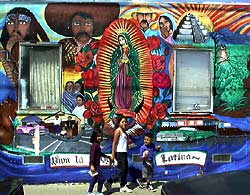
Thousands
upon thousands of faithful came to see the image of the Virgin seemingly
burned into the bark of a tree. The woman who witnessed the apparition,
not coincidentally, was a worker striking against the Watsonville Cannery
Company.
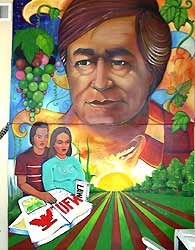
*Today,
Watsonville is again on the map as the site of yet another major labor
battle. The United Farm Workers, led for three decades by the legendary
César Chávez, is trying to organize the workers of the
strawberry fields.... it is a make-or-break campaign for the UFW, and
the protagonists, the fruit-pickers, are the newest of the New Americans:
migrants from Mexico, many of them from Michoacán...
Did
I mention that Watsonville has one of the lowest per-capita incomes
in the country?
Did
I mention that the frozen food plants that once employed thousands here
relocated after workers demanded better conditions? Did I mention that
the places those companies relocated to were in Mexico, to the very
states, Jalisco and Guanajuato, where the migrants who once worked in
those companies, came from? Is that what you'd call an irony of the
global economy?
Did
I mention that there is a 21 percent unemployment rate in Watsonville?
Did
I mention that Watsonville, a rural town, has a reputation for hardcore
youth violence?
The
house we're staying in is decorated with Chicano kitsch. An altar in
the living room with conch shell for burning incense, and Aztec calendar,
and Toltec figurine. Posters of Emiliano Zapata, icons of the Virgen
de Guadalupe. A Diego Rivera print. Malcolm X quote on the wall. Pictures
of kids dressed like theyr'e "down for the 'hood"–but
preaching violence instead of "payback."
We've
been staying at a house in Watsonville kept by Barrios Unidos, a non-profit
organization that does "intervention" and "prevention"
work with kids living in gang neighborhoods. It was founded by Daniel
Alejandrez, an ex-everything.
Vietnam veteran. Drug addict. Homeless. One of those miracle stories,
out of the ghetto and into community activism, now heading a multi-million
dollar organization.
By
all accounts, his organization has turned the lives of many troubled
kids around. It is also true that one such organization, or even many,
cannot change the future of an entire community whose fate is determined
by a complex set of social and economic circumstances...
We
run into trouble with a B.U. staffer. Joe and I ask him if he can steer
us in the direction of migrant youths who are caught up in "gang"
style and behavior, "assimilating" into a hardcore part of
American culture. We tell the young, pony-tailed activist that we've
seen evidence of kids imitating the gang style of East L.A. everywhere
from Arkansas to the highlands of Michoacán, where kids who've
never emigrated act "hard" and wear the uniform of the streets.
This is the dark side of migration and the globalization of culture,
we tell him.
But
he'll have none of our theorizing. "This is fucked up," he
tells us, looking at Joe's photographs of gang youth in East L.A. "This
is the type of crap that the media uses to stereotype all of us."
An
hour and-a-half-long conversation-confrontation ensues, Joe and I trying
to convince him that our goals are anything but sensational. I feel
like getting up and walking out, but I don't, mainly because B.U. is
hosting us and I don't want to appear ungrateful in the face of such
generosity.
At
a certain point, I accept the young radical's argument, which is basically:
You work for the media/ the media is owned by the rich and the white/
they will decontextualize your imagery and your ideas and make them
fit into their class-ist or race-ist conception of the world.
Joe
and I work for the media. Whatever we say appears in a context that
is clearly dominated by the point of view of the rich, and the white
in the United States, where class and race often intersect. Even if
we are allowed to present our imagery and ideas with "director's
cut" rights, our material still appears merely as a sidebar to
a much more powerful vision that does stereotype and diminish and distort.
Any
documentarian who believes his or her "truth" will remain
pure after it is received and processed through the million subjectivities
of the audience is gravely mistaken.
So
we have an impossible task.
So
we go on anyway.
In
the end, our B.U. radical relented and offered to help us in whatever
way he could.
Curious....
he wants what we want and we want what he wants in the end. He wants
to wield power in the aesthetic and political realm, the context within
which his troubled kids lead their lives. We, on the other hand, would
like to step beyond our role as representatives of the media, and touch
the lives of the kids, to help ease the pain of their individual existences.
Tomorrow
we'll call him back and see if we can meet with some of the immigrant
kids he's worked with.... kids from Michoacán, kids who are verging
on or who've already seen an American dream turn nightmare on the streets
not just of the big cities but also rural towns, like Watsonville....
We
right to you on the day that California held its primary election, which
featured Proposition 227 on the ballot, an intiative that would end
bilingual education. Over the past several months, many people of good
faith debated whether the system, which gives native-language instruction
on basic subjects to students while they are learning English, has served,
or failed, the huge immigrant children of California.
California
voters decided, nearly 3 to 1, that bilingual education has failed the
immigrant children.
But
we are concerned with an element of Prop. 227 that has nothing to do
with pedagogy. We are concerned with an undeniable xenophobic element
to the pro-227 campaign. There were voters–a minority, but a significant
minority–who said yes to 227 because they are tired of hearing
and reading the Spanish language–and the Mandarin, and the Farsi,
and the Korean–on the streets and on the airwaves of California.
But
language will not be dictated to by legislative measures.
Whatever
the schools of California do in terms of language instruction, Spanish
and Mandarin and Farsi will still be heard and seen. In Watsonville,
the strawberry fields echo with the languages of the past: Portuguese,
Armenians, Chinese, Japanese, German, Polish... and of course, the Mexicans
enunciating their lilting Spanish, the language of los files for many
generations now.
Many
of the Purépechas I know speak a fair English, Spanish, and some
of the indigenous dialect from Michoacán. We're embarrassed that
we speak only two languages. The sad thing for us about Prop. 227 is
that a mono-lingual solution is being offered for a California that
is no longer bi-lingual, but polyglot.
We
visited the campus of UC Santa Cruz today, looking up Gaspar Rivera,
a doctoral candidate in sociology who has offered help in guiding us
towards migrant families from Michoacán. Coincidentally, Gaspar,
a mixteco Indian from Oaxaca, has worked among the Purépecha
people of Cherán, Michoacán.
UC
Santa Cruz: gently rising, heavily wooded hills, an idyll that Joe and
I actually laugh at incredulously and derisively at first (we're city
boys visiting the provinces)... two fawns actually cross the road in
front of our car as we enter the campus. We climb higher and we get
a spectacular view of the northern California coastline: deep blue sea,
which seems to darken the blue of the sky and make the whiteness of
high clouds stand out all the more...
We
lunch with Gaspar at a taco place on campus. A taco place. Santa Cruz,
which neighbors Watsonville, is a very liberal place, but is also very
monocrhome. The poor, mostly Mexicans, are segregated down by the boardwalk
in an area called Beach Flats, once the site of summer homes for the
rich and the white.
At
any rate, Gaspar tells us that he knows a woman from Cherán,
a woman he says we must meet. We drive up to Watsonville.... and instead
of pullng up before some sort of shantytown, we park in front of a home
that can only be described as middle-class, perhaps even upper middle
class, with long green lawn out in front, and a wood-shingle roof, and
many bedrooms, and a double-door refridgerator.
Reyna
Guzmán is the woman's name. And we'll get to know her story–which
includes being a protagonist in the labor struggle at the Watsonville
Cannery Company, and being a single mom, and being a Purépecha
Indian, and a political activist on both sides of the border, and being
an all-around rebel and entrepreneurial genius. We just met her today.
Tomorrow, we'll go back to her house and talk to her about her past,
her present and her future. We'll talk about her kids, about America,
about Mexico.
We'll
talk about the road.
Ruben Martinez
Share
your comments with us
|