|
WATSONVILLE, CA.
I'm
going to allow myself to riff on the "process" of this project here...
we've been in the field four days, but feel an exhaustion of more like
4 weeks already. Up at 6:30 a.m. Phone calls, emails, faxes. Tracking
down contacts. Dead-ends. Interviews. Some that lead to insight, others
only to cliche.
All
this would be normal but for the fact that we are working in a new medium.
Joe has less computer experience than I, and I don't have much. We return
to the Barrios Unidos house in the early evening. Dinner. At ten or
so we start to edit the day's material. We send the dispatch after midnight,
meaning we've been working 18 hours a day.
Then
there is the confusion as to what we're actually doing–whether
Joe's photographs should mirror what I'm writing, in direct and literal
ways, and vice-versa. The issue of sound. The computer crashes. Our
cyber-ignorance. All of this adds time and frustration to the daily
grind.
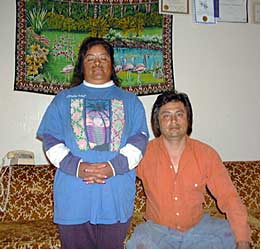
I
feel like we're all (Zonezero staff, Joe and myself) involved in something
exciting and new, an open field full of possibility. But thinking in
"virtual" terms still does not come naturally to me. The time-space
of a virtual page on the web is not the same as a newspaper or magazine
page. I'm not sure what this means in literary terms yet. More compression
of ideas and images? Or a search for a completely different language
that constructs a new relationship between word and image, especially
now that we have sound capability (and, shortly, video)?
__________
And
it's not as if I've resolved, to my own satisfaction, certain basic
issues that've been around for over the better part of a century in
terms of the collaboration between photographer and writer. A photographer
can choose black and white or color–the first, essential, formal
choice on a project. Joe initially envisioned the New Americans in black
and white; now he's working in color. It's not that I'm suggesting that
Joe and I must "see" our subject in the same way, but it does make me
wonder about my own formal choices. Is there an equivalent, for a writer,
of the choice between "black and white" and "color"?
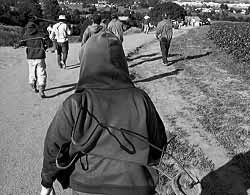
It
is difficult to envision this landscape in black and white, although
the contrasts can very sharp ones. Early summer in the Pajaro Valley:
the bright green of crops and wild grass nearing the peak of the season,
and the Santa Cruz mountains, thick with stands of eucalyptus and pine
and fir, fog curling over the ridges in the early mornings and late
afternoons. The colors are so strong that the shadows aren't noticeable.
The contrast between the different shades of green, which battle one
another across the valleys and hills, gives the area a tense beauty.
Watsonville
and Santa Cruz are places of extreme contrast. I am thinking of a particular
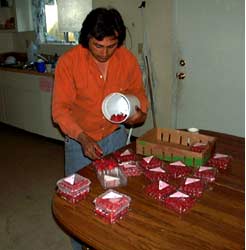
image from yesterday afternoon. The Rivera family, fruit pickers that've
lived in the area for 14 years. We arrived at their house–a unit
in a low-income complex east of downtown Watsonville–in the early
evening, just as Saturnino and María were returning from the
fields. María had already had a chance to wash her hands of the
stains from the blueberries and raspberries, Saturnino hadn't; it looked
like he'd dipped his hands into a palette of midnight blue acrylic that
seeped deep into each and every crack and crevice of his brown hands.
She'd painted her fingernails a silvery pink.
The
Rivera's American Dream has hit a dead-end. The house they are living
in, three bedrooms and two baths, is better than they've ever had here,
but they'll have to move soon. Saturnino says the family no longer qualifies
for low-income housing, because he returned to the picking fields instead
of finishing a job-training course, a requisite for staying here.
Before
this house, the Rivera's lived in a series of rundown trailer homes
of rotting ceilings and nightcrawlers biting the children in their beds
and heaters that nearly choked them with smoky fumes.
Saturnino
would rather they return to Mexico than go back to a trailer. He dreams
of starting up a small business. "I'm tired of the patrones,"
he says. They'll take what they've saved up here and open a small bakery,
perhaps a general store.
She
chances of such a business surviving in their rural Mexican town are
just about nil. Saturnino's optimism is probably the only thing he picked
up in the United States that he'll actually be able to take back with
him to Mexico.
____________
And
then there's the granola-eating, bike-riding, yellow-haired mid-class
residents of Santa Cruz. They listen to World Beat music on the radio.
They love their Mexican food at the dozen high-class taquerías
in town. They shop at health food stores. They want to save whales and
seals and they all have dogs.
They
are very liberal. There is a self-declared socialist on the City Council.
Peace and Love...
This
world coexists in the same space with that of the migrants. And there
is no contact whatsoever between them, at least directly, face to face,
that is. The Mexicans, an insurgent, rapidly growing minority, suffer
the invisibility of servitude. The boardwalk in Santa Cruz is kept clean
by an army of Mexicans. The white tourists arrive and their color overwhelms
the migrants.
And
yet, the future of the one depends on the other....
_______
I
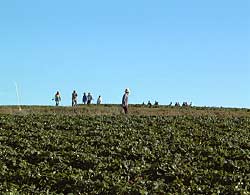
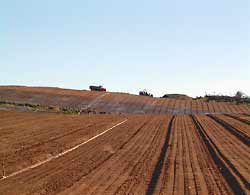
am standing on a long hill, domed gently like the sky, a strawberry
field owned by the Ramos family of Guanajuato. Miguel Ramos, el patrón,
is talking about how El Niño destroyed some farms because of
flooding, but not his. He'd taken all the precautions. "The rains actually
helped wash away the salt that had built up in the soil because of the
pesticides and fertilizers used over the decades," he said. "I'm actually
doing great."
But
he is experiencing a shortage of pickers this season. He attributes
it to the crackdown at the border. Before, women and young men were
common in the fields. Now, it's mostly men in their 20s and 30s. It
is simply getting more and more difficult to breach the border, and
only the most hardy and experienced crossers are making it, and even
for them it is increasingly a life-and-death risk.
"The
border patrol knows that it is putting people in the position of risking
their lives," says Miguel Ramos. "It knows that they will risk their
lives as long as there's jobs and the shot at the future here. I don't
know how a country that calls itself civilized can promote such a policy."
It
is six o'clock. The field workers break for the day and in a long, scraggly
line make for a tree where they've hung their backpacks. Now the field
is empty, the dome long as the horizon, the mint green leaves of the
strawberry plants rustling slightly in the cold wind that rises under
a suddenly hard, metallic blue sky.
This
is the field that Benjamín, Salvador and Jaime Chávez
worked, the field they were on their way to when the GMC truck they
were crammed into along with 21 other migrants overturned and crashed
just before the dawn of an April morning in 1996.
Their
story, of course, must be told in black and white.
_________
Rubén Martínez
Share
your comments with us
|