|
|
ESPAÑOL |
|
WATSONVILLE, CA.
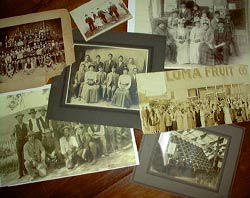
A few days ago, driving through town, we came across one of Watsonville's several old cemeteries, next door to Valley Catholic Church, which offers Mass in Portuguese as well as English. Joe and I walked into the city of the dead together, taking separate routes among the hundreds of ornate family tombs. Some of the birthdates went back to the early 1800s, the deaths to the 1860s. The surnames tell the early history of Watsonville, the migrant story of 19th century America: Martinelli... Crosetti... MacCaughey... Resetar... Driscoll... Scurich.... Murphy... Holohan... Braycovich... Tomassi... Lopes.... Dias... Barovac... Immigration, of course, is nothing new to Watsonville. We visit with Mrs. Jayne Borg, of the Pajaro Valley Historical Society. Borg, an amateur historian, effusively rattles off the migrant history of the area. The first migrant magnet was the gold rush. Most of the arrivals didn't make their money finding the Mother Lode; they did, however, find a rich soil that would turn California into the nation's breadbasket. I am particularly interested in whether the conditions for the early immigrants to the area were in any way similar to what we see today. They were. Perhaps they were even worse. The famine Irish crossed the sea in ships almost reminiscent of the Middle Passage, with many dying before reaching the mainland. It was similar for those making the journey across the Pacific from Asia. The recently arrived migrants took their place at the bottom of the economic ladder, working in the fields of the Pájaro Valley, or, as in the case of the Portuguese and other ethnic Europeans, in the fishing and canning industries. Borg brings out a succession of photographs, many dating back to the late 1800s. Sepia with age, I scan the faces and try to imagine the lives. Perhaps it is merely my own romantic interpretation of the migrant narrative, but I seem to see on the faces of the Chinese, Slavs and Portuguese, looks that speak of hardship and otpimism at once. The selfsame look I see on the faces of the Mexicans today.
Borg recalls the various chapters of racism and discrimination–the Chinese Exclusion Act, the Japanese Internment of World War II, the Repatriation of the 30s. In every case that Americans legislated against "foreigners," economics was a factor. With each recession, and, of course, with the Great Depression, the immigrants were looked upon as a cause, and their removal as a solution. Proposition 187 can be seen as the climax of an anti-immigrant trend that began not just with the arrival of millions of Latin American immigrants to the United States in the last 20 years, but also with the dramatic restructuring of the U.S. economy and the loss of its old industrial foundation. Today, however, the economy is booming in California and throughout the nation. Unemployment is at nearly a historic peacetime low, inflation is down. And yet, anti-immigrant sentiment is still notable. Has what was essentially a conflict of economics turned into a real culture war? Borg's lack of pretention, generous hospitality, and liberal politics reminds me of the white Americans with whom I've always felt at ease around (in my youth, I lived in a neighborhood where my friends were the sons and daughters of red-diaper baby Jews, Anglo Unitarians and the like). She likes to see the world through the point of view of the immigrants: She is optimistic. "For some of the old families it took four generations to work their way out of the fields and canneries into college and good jobs," she says. "We hope that it doesn't take four generations for the people arriving here today." ___________ We stop by Ramos Farms one last time. I speak with Miguel's wife Irene, who happens to be a first-generation Portuguese immigrant herself, although she's had family in the area for decades. Among her distant relatives were fishermen and cannery workers. She is slightly more sympathetic than Miguel to the migrants who yearn for the Old World. She talks of the Azores, her voice earnest and suddenly, incredibly poetic: "I remember running barefoot through the orchards, carefree, my cousins playing, my mother calling out to us . . . "
The memory of the migrant, it occurs to me, may be as necessary for success in this country as a fierce ambition for the future. Without a past, there can be no future; the journey from Old to New World would become meaningless. _________ Our last full day in Watsonville. I feel like we've only begun to capture something of the life here. This is the constant challenge of documentary work: the downsized economics of modern media rarely offers the journalist the time to gain intimacy with his or her subject. James Agee and Walker Evans, whose 'Let Us Now Praise Famous Men" has been a guiding light for this project from the start, spent months living with the people whose stories they so movingly told. One week is better than one day–the typical parachute-journalist's timeline–but it is still not enough. ____________ We say goodbye to Reyna Guzmán. Her children are attending a pow-wow on Mount Madonna, on the outskirts of town, dancing Aztec dances, pounding Aztec drums, even though the aesthetic has little or nothing to do with their Purépecha roots. Reyna arrives home from the market in a beat-up early eighties Datsun, rushing as always. There's lunch to cook, and dinner. These days, she does practically nothing else; she prepares breakfast for the kids before cooking at the restaurant, returning in the afternoon to start lunch, taking only a short break before starting dinner. We hadn't noticed the Cadillac before, because the carport is at the far end of the house and we hadn't walked around the whole property. The Cadillac, an '82 model, a big boat with a dulling silver-gray paint job, is her pride and joy. She bought it for $1500 from an acquaintance who needed quick cash. "I love big, old cars," Reyna says.
She enthusiastically poses for Joe, letting her hair down and acting quite–there's no other word–sexy, almost as if she's modelling for Lowrider magazine. Under the relentlessly gray, drizzly sky, Reyna gives us a tour of her garden, her other pride and joy. It is rare for poor Mexicans to carefully cultivate gardens back home–horticulture is the domain of the upper classes. At most, people back home in Cherán fill a few old tin jalapeño cans with earth and a plants picked from the wild. But Reyna's years of hard work have given her the middle-class right to her own garden. A long, carefully cut lawn. Rows of peach trees budding with new fruit. Beds of geraniums blooming a bright violet, begonias, lilies, gladiolas. Bright green ferns crawling up the side of the house. (Even inside the house, there are impressive vines reaching up from the floor and running along the walls.) Among these species, which are typical of any "American" garden, she has placed a bit of Mexico: nopales and magueys, a guava tree, and an avocado so young it doesn't bear fruit yet. She's particularly proud of the avocado. She planted the seed in a soda can two years ago and transplanted it just recently. And then the herbs that she uses for home remedies, also from her memory of home: sage, mint...
Every day she spends at least an hour in the garden before going to work, and then another hour or longer in the twilight of evening, "until I can't see what I'm doing anymore." "The garden gives me so much happiness," Reyna says. "To see the bud appear and then break open and flower is so beautiful." –––––––– Sunday afternoon, Watsonville. We are on our way out of town. Joe and I are tired and bickering. I wind through the barrio near downtown before heading out on the highway, and Joe gets restless again, because of what he sees on the streets: the migrants are all at home, hanging out on front porches and front lawns. The children play. The men knock back a few beers. Music is playing.
Everyone is dressed in bright, clean clothes, the one day of the week they can do so because there'll be no dirt or mud from the fields, no grease splattering, no dirty dishwater from a restaurant job. It is the first time we've seen Watsonville alive in daylight. During the week, it is a ghost town. One day of rest (most everybody here works six days a week, and at the peak of picking season, many work seven). Tomorrow morning, the town will empty out again, and the fields will be full. ____________
|
|